
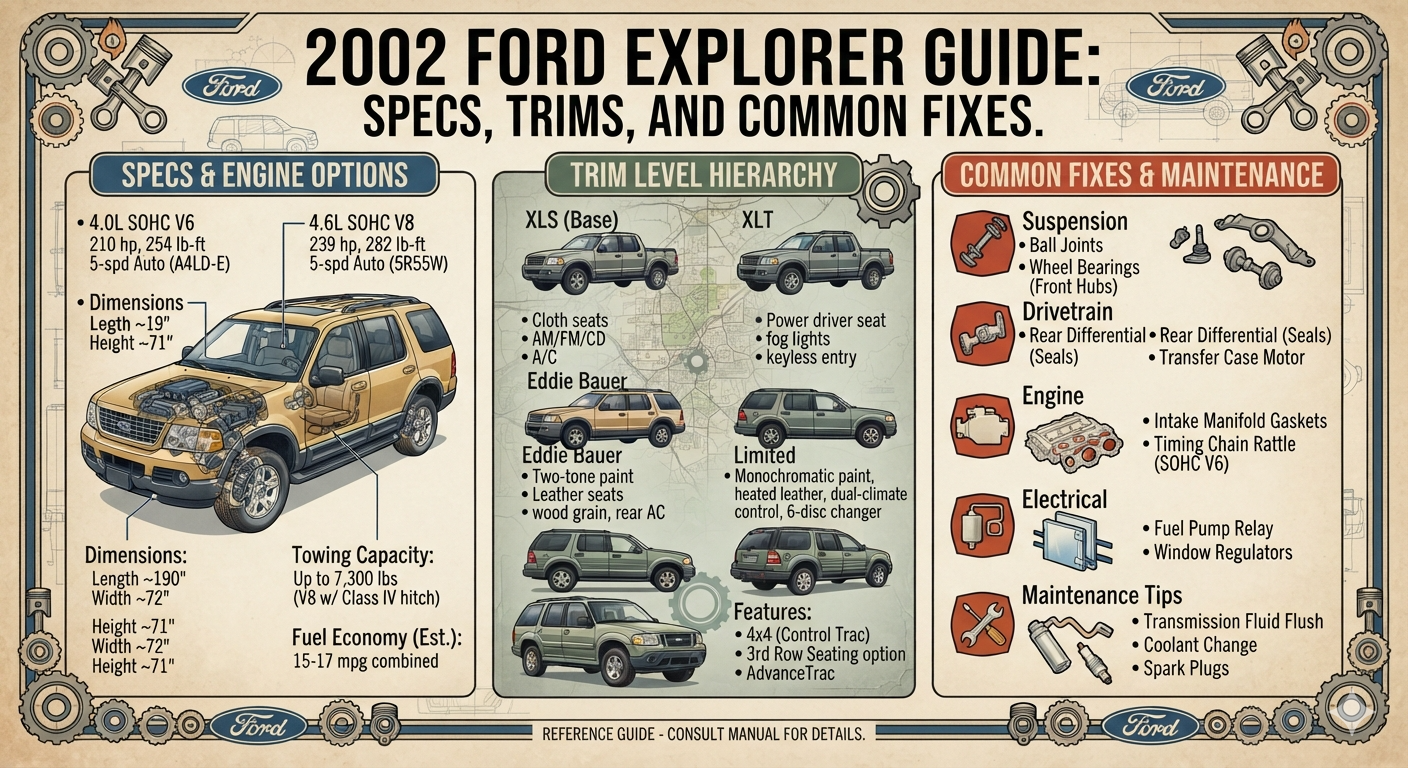
The 2002 Ford Explorer stands as a major milestone in American automotive history. When Ford rolled out this model year, it was not just a minor refresh. It was a complete, ground-up redesign that introduced a brand-new independent rear suspension, a wider stance, and a massive jump in overall passenger comfort. Whether you are looking at a classic 2002 Ford Explorer to buy as a budget-friendly family hauler, or you already own one and need to fix a stubborn transmission or electrical issue, you are in the right place.
In this comprehensive guide, we will break down the entire vehicle lineup from the rugged 2002 Ford Explorer sport trac to the luxury-focused 2002 ford explorer eddie bauer. We will also dive deep into real-world maintenance, covering critical areas like the 2002 Ford Explorer transmission, finding the right 2002 Ford Explorer battery, and locating the 2002 Ford Explorer fuse box diagram. Let’s jump into the ultimate owner’s manual and buyer’s guide for this classic SUV.
The Redesign That Changed Everything
When Ford released the third-generation 2002 Ford Explorer, they had a massive goal. They needed to make the SUV handle more like a car while keeping its rugged capability. Ford achieved this by ditching the old solid rear axle and installing a modern independent rear suspension. This single mechanical change lowered the floor, improved ride quality immensely, and allowed Ford to add a third-row seat for the very first time.
Additionally, this redesign widened the track by two inches. This change gave the SUV a much more stable footprint on the highway and solved many of the rollover concerns that plagued previous generations. This combination of space, utility, and comfort quickly made it one of the best-selling mid-size family vehicles in North America.
Exploring the Trim Levels: XLS, XLT, and Eddie Bauer
Finding a 2002 Ford Explorer for sale today means encountering a variety of trim packages. Ford wanted to make sure there was an Explorer for every budget and lifestyle. The base model, known as the 2002 Ford Explorer XLS, served as the budget-friendly entry point. It came with manual cloth seats, standard power windows, and basic steel or alloy wheels. It was a straightforward workhorse built for simple daily commuting and utility.
Stepping up, the popular 2002 Ford Explorer XLT was the absolute sweet spot for most families. The XLT trim added nicer alloy wheels, a power driver’s seat, keyless entry, and optional third-row seating. For those seeking premium comfort, the top-tier 2002 Ford Explorer Eddie Bauer edition featured a signature two-tone exterior paint job, luxurious leather seating, automatic climate control, and woodgrain interior accents.
| Trim Level | Seating Capacity | Key Features |
| XLS | 5 | Cloth seats, manual climate control, basic utility features |
| XLT | 5 to 7 | Power driver’s seat, upgraded wheels, optional third-row |
| Eddie Bauer | 5 to 7 | Two-tone paint, premium leather, automatic temperature control |
The Unique Offshoots: Sport and Sport Trac
If you wanted something a bit different than the standard four-door SUV, Ford offered two specialized variants. The first was the 2002 Ford Explorer sport, a sporty two-door version. It kept the previous generation’s shorter wheelbase and rugged styling, appealing to younger buyers who wanted a nimble, fun-to-drive daily cruiser with plenty of ground clearance.
The second, and highly successful, variant was the 2002 Ford Explorer sport trac. This was an innovative, early “sport utility truck” that combined a comfortable four-door crew cab with a short composite cargo bed in the back. Because of its unique utility, finding a well-maintained 2002 Ford explorer sport trac for sale is still highly common today, as outdoor enthusiasts love using the composite bed for hauling dirty gear, bikes, and camping supplies without ruining the passenger cabin.
Understanding the 2002 Ford Explorer Interior
Step inside a well-preserved 2002 Ford Explorer interior, and you will immediately notice how incredibly spacious and open it feels for a vehicle from this era. Thanks to the independent rear suspension layout, Ford engineers managed to lower the rear floorboards significantly. This simple design change freed up enough interior room to comfortably fit an optional, fold-flat third-row seat that could accommodate children or small adults on short trips.
The dashboard layout is highly functional, placing physical buttons and knobs exactly where you expect them to be. Standard models came with highly durable cloth upholstery designed to withstand messy family road trips, while the Eddie Bauer and Limited trims treated passengers to heated leather buckets up front. Overall cargo room is generous, offering plenty of space when both rear rows are folded flat into the floor.
Under the Hood: Engine Options and Specs
When buying a used 2002 Ford Explorer, you will typically find one of two powerplant options under the hood. The base 2002 Ford Explorer engine is a reliable 4.0-liter V6 producing 210 horsepower. This single-overhead-cam (SOHC) engine offers decent acceleration and towing capability for daily driving tasks. However, it is highly critical to listen closely for any loud rattling noises from the front or rear of the engine block when starting it cold, as these V6 engines are notorious for plastic timing chain guide wear over time.
For heavy-duty towing and maximum power, Ford offered an optional 4.6-liter modular V8 engine. This all-aluminum V8 pumps out a robust 239 horsepower and offers a much smoother power delivery. The V8 is generally considered highly durable and does not suffer from the same timing chain guide weaknesses as the V6, making it the preferred choice for drivers who regularly haul boats, trailers, or heavy cargo.
Navigating Transmission and Fluid Maintenance
The automatic 2002 Ford Explorer transmission is one of the most critical areas to inspect before purchasing or driving this vehicle. The 5-speed automatic gearboxes (specifically the 5R55W model used this year) are well-known in the automotive community for experiencing solenoid block failures, worn servo bores, and hard shifting between second and third gears. If you notice a flashing “O/D Off” light on your dashboard, it is a clear warning sign that the transmission computer has stored a diagnostic trouble code.
Keeping your 2002 Ford Explorer transmission fluid fresh is the single best way to extend the lifespan of these sensitive gearboxes. Unlike older vehicles with a traditional under-hood dipstick, this transmission is a “sealed” unit. Checking and filling the fluid requires a special adapter tool underneath the vehicle while it is running at operating temperature. Always use high-quality Mercon V fluid to ensure the internal clutches and bands engage smoothly without slipping.
Crucial Under-the-Hood Parts: Battery, Alternator, and Oil Filter
Keeping your SUV running smoothly requires keeping up with basic electrical and mechanical maintenance. A healthy 2002 Ford Explorer battery is essential to power the vehicle’s complex electronics and starter motor. The correct battery size for this model year is a Group 65, which fits perfectly into the engine bay tray and provides plenty of cold-cranking amps to turn the engine over in freezing winter weather.
If your battery is constantly draining or your headlights flicker at night, your 2002 Ford Explorer alternator may be failing. The alternator keeps the electrical system charged while driving, and replacing a worn-out unit is a very straightforward DIY project using basic hand tools. Additionally, when performing regular oil changes, ensure you use the correct 2002 Ford Explorer oil filter (typically an FL-820S for the V8 or an FL-820S/FL-400S depending on your specific engine variant) to keep your engine oil clean and free of harmful debris.
Solving Fuel Delivery Issues
If your SUV cranks over smoothly but refuses to start, or if it sputters and loses power while accelerating up a steep hill, you might be dealing with a failing 2002 Ford Explorer fuel pump. The fuel pump is located directly inside the gas tank, meaning you have to carefully lower the heavy metal tank from underneath the vehicle to replace it.
Before committing to a difficult fuel pump replacement, always check the simpler parts of the fuel system first. Start by checking the fuel pump fuse and the fuel pump relay in the main engine bay power distribution box. Additionally, replacing the inline fuel filter mounted along the inner frame rail is a cheap, easy maintenance task that can instantly restore proper fuel flow and save you from an expensive repair bill.
Finding Your 2002 Ford Explorer Fuse Box Diagram
Electrical glitches can be highly frustrating, but they often trace back to a simple blown fuse. To find out which fuse controls your radio, power windows, or headlights, you will need to reference a 2002 Ford Explorer fuse box diagram. This vehicle features two main fuse panels designed to protect its electrical circuits:
- Passenger Compartment Fuse Panel: Located under the driver’s side dashboard, near the steering column and parking brake pedal. This panel houses fuses for interior lights, power mirrors, and cabin accessories.
- Power Distribution Box: Located under the hood on the driver’s side of the engine bay. This box contains high-current fuses and main system relays for your starter, fuel pump, and cooling fans.
Keeping a spare fuse kit and a basic plastic fuse puller tool in your glovebox can save you from being stranded on the side of the road over a simple electrical issue.
Wheels and Customizations: The Lug Pattern
If you plan on upgrading the wheels on your SUV or buying a spare set of rims for winter tires, you must know the exact 2002 Ford Explorer lug pattern. This vehicle uses a very common and highly popular 5×114.3mm (also widely known as 5×4.5 inches) bolt configuration. This five-lug design has been a standard across multiple generations of Ford SUVs and mid-size trucks, making it incredibly easy to find affordable aftermarket wheels or factory replacements.
When mounting new wheels, always ensure they are hub-centric to match the center hub diameter of the vehicle. This prevents high-speed wheel vibrations and ensures the weight of the SUV is properly distributed across the hub rather than relying entirely on the lug nuts. Always torque your lug nuts in a classic star pattern to 100 lb-ft to ensure they stay safely secured while driving.
Conclusion
The 2002 Ford Explorer remains a legendary, highly capable mid-size SUV that offers a spacious interior, decent towing power, and a comfortable ride. While it does require careful attention to key areas like transmission fluid, timing chain noise, and fuel delivery systems, keeping up with regular maintenance can reward you with a highly dependable vehicle that cost-effectively gets your family, gear, and trailers wherever they need to go.
Frequently Asked Questions
What is the bolt pattern for a 2002 Ford Explorer?
The standard 2002 Ford Explorer lug pattern is 5×114.3mm, which is also widely referred to in the United States as 5×4.5 inches.
How often should I change the transmission fluid?
To keep the sensitive automatic 2002 Ford Explorer transmission running cool and shifting smoothly, it is highly recommended to perform a fluid exchange and install a fresh filter every 30,000 to 50,000 miles using Mercon V fluid.
Where is the fuse box located inside the cabin?
The interior passenger compartment fuse panel is located directly under the driver’s side dashboard, positioned just to the left of the steering wheel column near the parking brake pedal.
What are the main warning signs of a failing fuel pump?
Common warning signs of a failing 2002 Ford Explorer fuel pump include a loud whining noise coming from the rear gas tank area, difficulty starting the engine, random engine sputtering under load, and a sudden loss of power while driving at highway speeds.
Can I install third-row seats in a base XLS model?
While the higher-end 2002 Ford Explorer XLT and Eddie Bauer trims came with optional third-row seats, the base 2002 Ford Explorer XLS came as a dedicated five-passenger SUV. Retrofitting a third-row seat into a base XLS is extremely difficult, as the body lacks the factory floor anchors and seatbelt mounting points.
Which engine is more reliable: the V6 or the V8?
While both engines offer decent performance, the optional 4.6-liter V8 engine is generally considered more durable over the long run. The 4.0-liter V6 engine is known for developing timing chain guide wear, which requires an expensive repair process to correct.